Map the whole system
Eight layers reveal the conditions shaping function now.
A SYSTEMS THEORY OF HUMAN MENTAL HEALTH
Mental health is not produced by one organ, one diagnosis, or one life event. It emerges from the interaction of body, development, relationships, behavior, cognition, environment, meaning, and society.
Map the architecture. Understand the dynamics. Find the leverage point.
SCROLL TO DISCOVER ↓
Physiologic ↔ Developmental ↔ Relational ↔ Behavioral ↔ Cognitive–Emotional ↔ Physical–Environmental ↔ Existential ↔ Structural–Societal
Eight layers reveal the conditions shaping function now.
Coupling and feedback explain why effects propagate.
Load, reserve, and vulnerability locate the threshold.
Prioritize changes capable of improving several layers.
THE CORE IDEA
The current operating model follows five levels: architecture → dynamic pressure → adaptive remodeling → functional state → time + feedback.
THE COMPLETE SYSTEM
This visual brings the layers, interactions, reserve, thresholds, and functional states into one map. Open it at full size to follow the complete pathway.
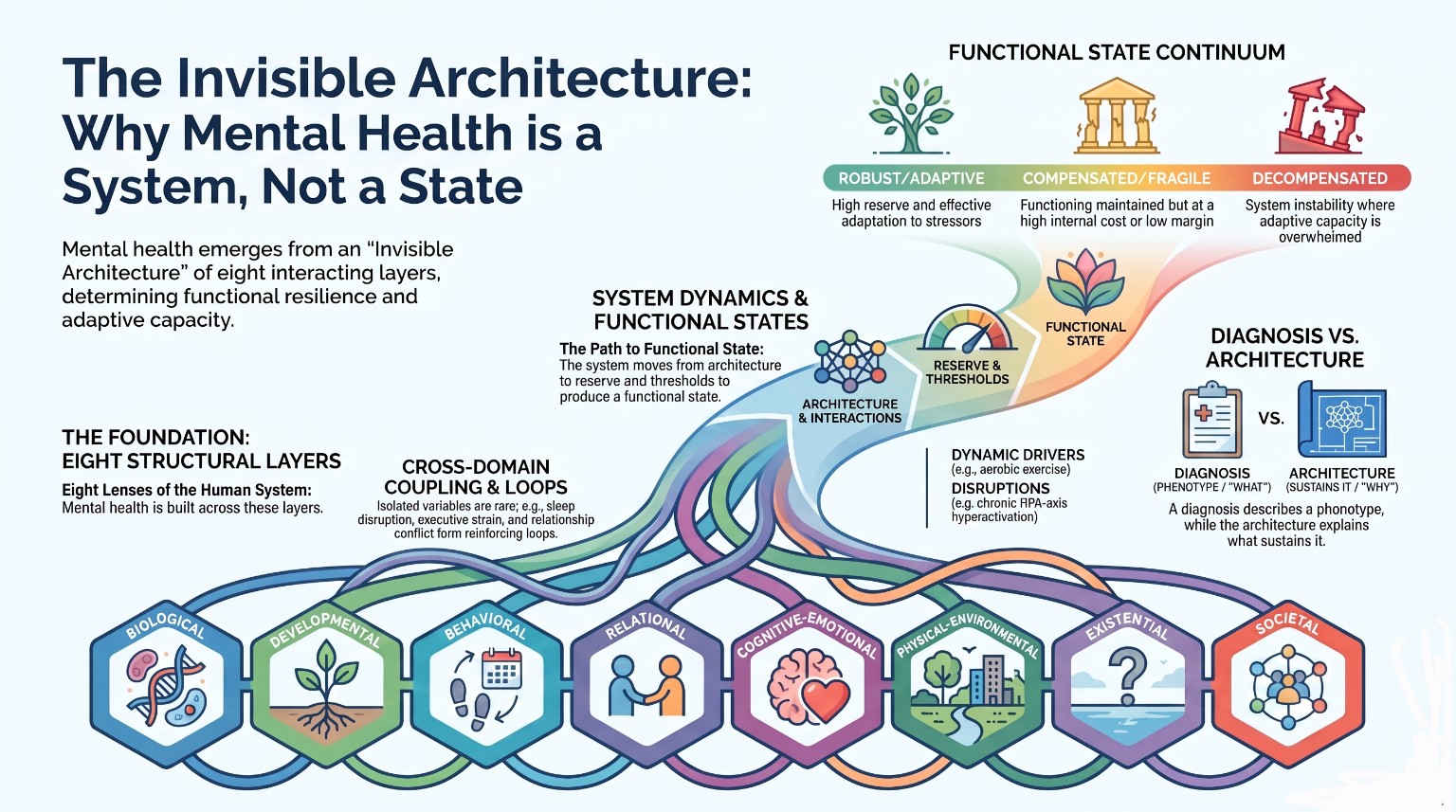
THE EIGHT LAYERS
Each domain contains loads, vulnerabilities, active protective architecture, and potential leverage points. No domain is independent, and the same exposure can have different effects depending on reserve, timing, history, and recovery.
What the body is making easier or harder for the mind to do.
Explore evidence →02How the system was built, trained, and adapted across time.
Explore evidence →03Who co-regulates, supports, threatens, or repeatedly dysregulates.
Explore evidence →04What is repeatedly done, avoided, consumed, and reinforced.
Explore evidence →05How experience is predicted, appraised, remembered, and regulated.
Explore evidence →06What the material environment repeatedly does to physiology and behavior.
Explore evidence →07What makes effort, suffering, responsibility, and the future worth engaging.
Explore evidence →08Which upstream rules distribute exposure, protection, opportunity, and recovery capacity.
Explore evidence →CROSS-DOMAIN COUPLING
Sleep disruption can alter autonomic regulation and executive control; impaired regulation can increase conflict and rumination; conflict and rumination can further disrupt sleep. The clinically important unit is often the loop, not the isolated variable.
ADAPTIVE REMODELING
Under appropriate conditions, manageable challenge followed by successful regulation, learning, and recovery may increase future capacity. Excessive, chronic, uncontrollable, poorly recoverable, or developmentally disruptive demand can instead sensitize or deplete the system.
FUNCTIONAL STATE + RECOVERY TRAJECTORY
A person can look well while compensating at high cost, or experience intense distress while still adapting effectively. Functional state and psychiatric diagnosis are related—but not identical—variables.
Reconstruction is the recovery trajectory: rebuilding reserve, redundancy, flexibility, and function after destabilization.
THE CENTRAL SHIFT
Diagnosis remains clinically important. The Invisible Architecture adds a systems question: what combination of structure, load, reserve, vulnerability, coupling, and history produced the current state?
WHERE TO GO NEXT
SCIENTIFIC LIBRARY
The Resource Center distinguishes established evidence, systems-level synthesis, and hypotheses generated by the framework, with DOI and PubMed links where available.
CONVERSATIONS
Long-form conversations about the science, environments, relationships, ideas, and lived experiences that shape human mental health.
PODCAST
Published posts assigned to the Podcast category will appear here automatically.
Visit the podcast page →